
How to Play the Palworld Card Game: A Beginner’s Guide

Welcome to the Palworld Official Card Game! It’s a two-player battle where you lead a team of Pals, spend Souls to bring them out, and race to knock your opponent’s life down to zero. This guide walks you through every piece of the game, the cards, the numbers on them, and the rules for building a deck and playing a match — so you can sit down and play with confidence.
The goal of the game
Both players start with 10 life. Your mission is simple: reduce your opponent’s life to 0 by attacking with your Pals. Do that, and you win.
What you bring to a game: two decks
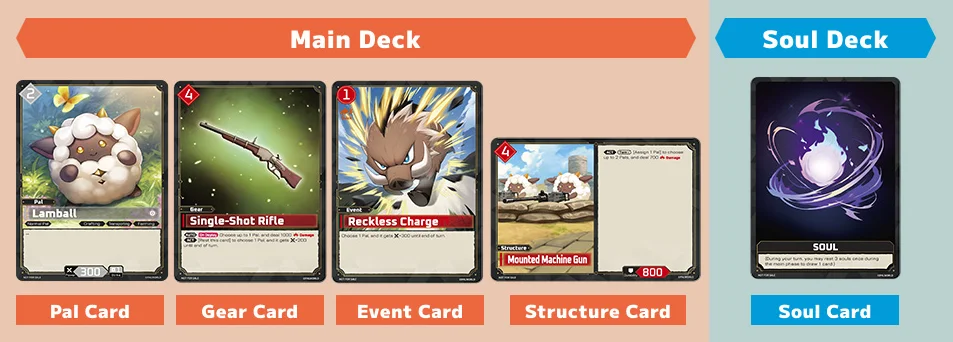
In Palworld you play with two separate decks:
- Main Deck — exactly 50 cards. Your Pals, gear, events, and structures. This is where your strategy lives.
- Soul Deck — exactly 10 cards. Made only of Soul cards. Souls are your energy/resource, you’ll spend them to play everything else.
The five kinds of cards
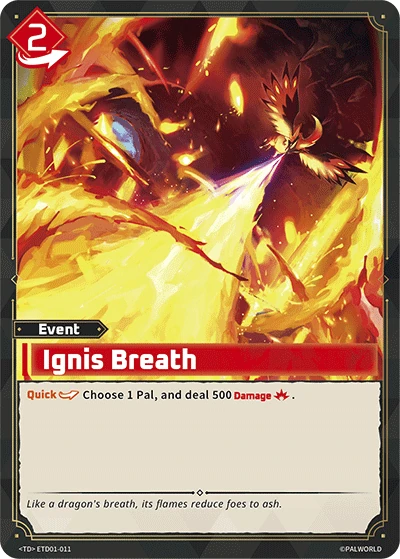
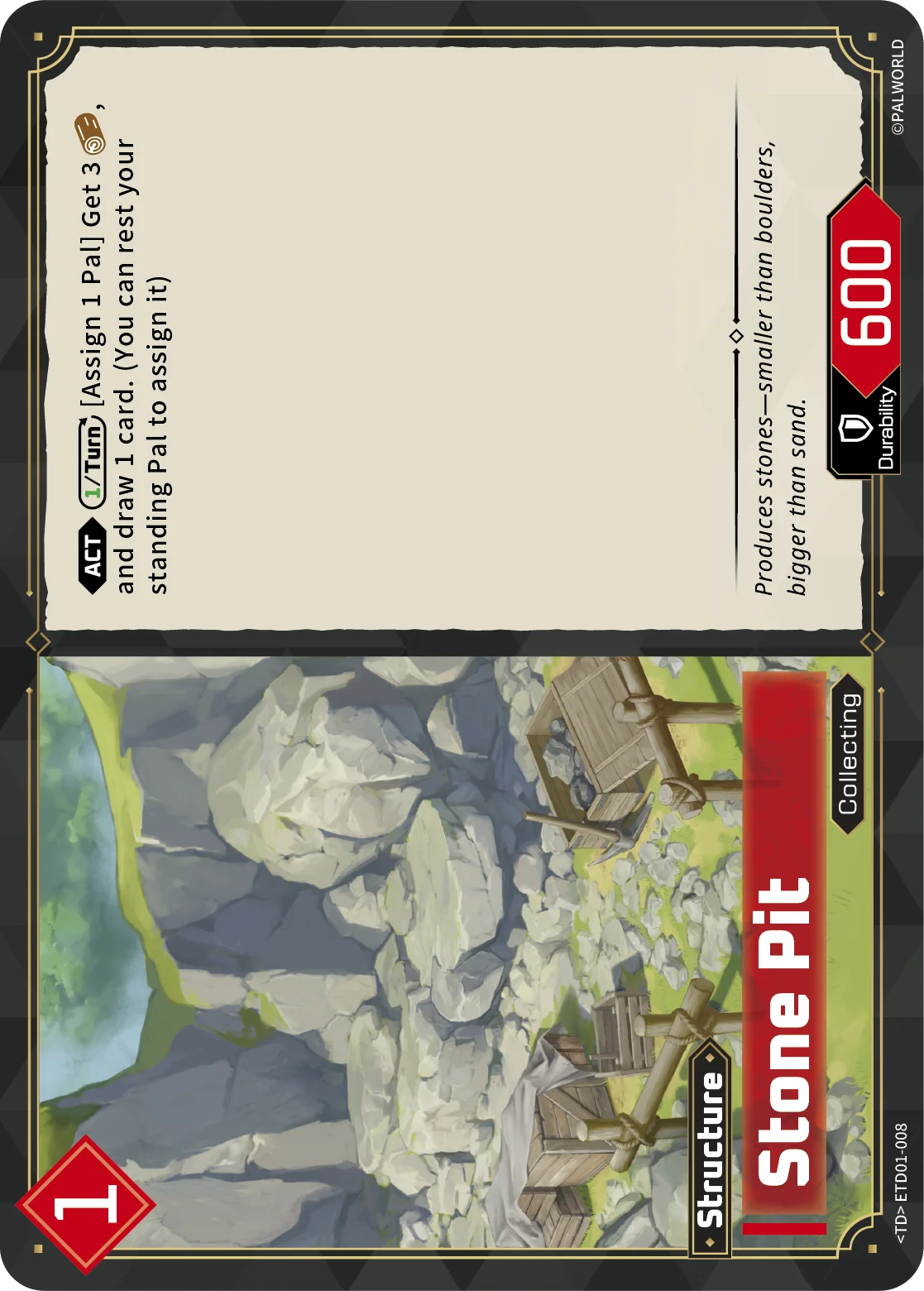
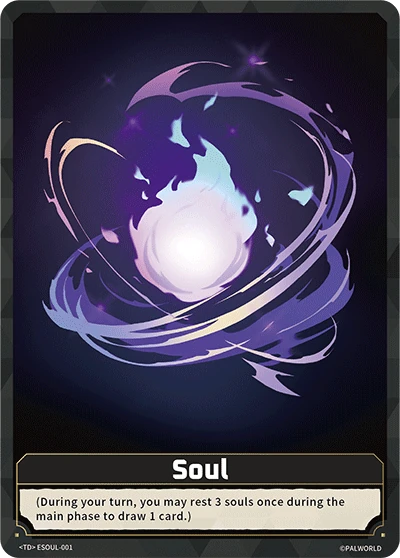
Every card is one of five types:
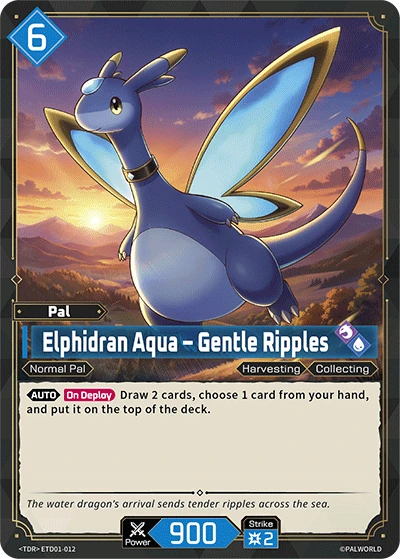
- PAL: Your creatures. They attack, defend, and are your main path to victory.
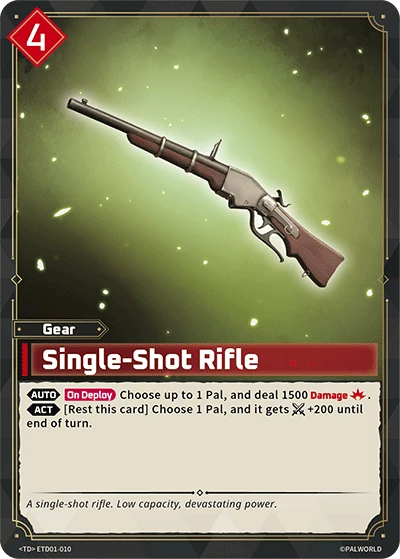
- GEAR: Weapons and tools that boost your Pals.
- EVENT: One-time effects you play from your hand for an instant impact.
- STRUCTURE: Buildings that stay in play. They’re laid sideways (horizontal), and you can assign Pals to them to activate powerful abilities.
- SOUL: Your resource cards, which live in the separate Soul Deck.
The five colors
Cards come in five colors, and color shapes what your deck can do:
There are four main colors in the game: 🔴 Red, 🔵 Blue, 🟢 Green, and 🟣 Purple.
Each color has its own identity, a distinct playstyle with its own strengths and weaknesses. Part of the fun is finding the color that matches how you like to play, then learning how to lean into what it does best while covering for where it’s weak.
When you build a deck, you can use up to two of these colors, so you might go all-in on a single color, or blend two of them to combine their strengths.
Then there’s ⚪ Colorless. Colorless cards don’t count toward your two-color limit, so you can add as many of them as you like on top of your two chosen colors. Think of them as universal cards that fit into any deck.
How to read a card
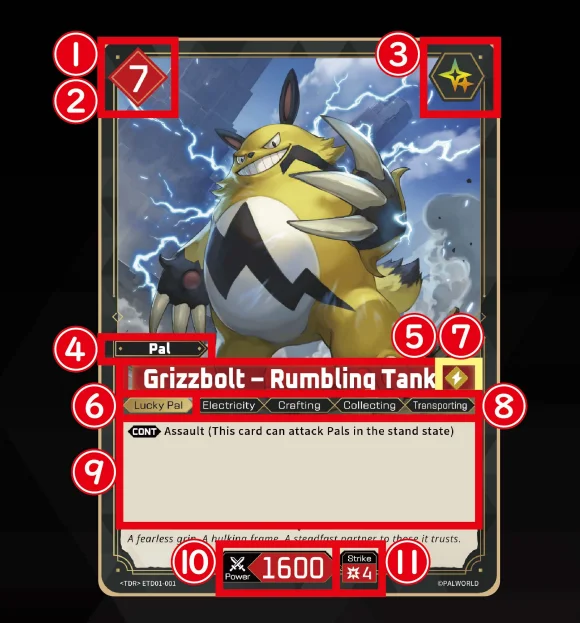
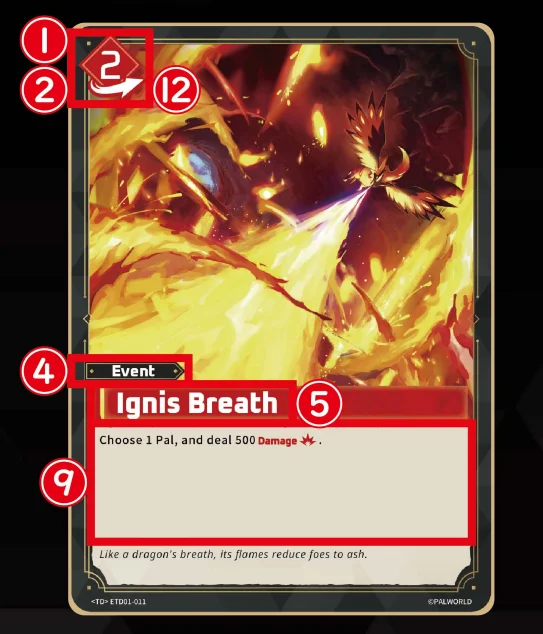
Here’s what all the symbols and numbers on a card mean:
- Cost — How many Souls you spend to play the card.
- Color — The card’s color (Red, Blue, Green, Purple, or Colorless), shown by the color of the cost symbol.
- Lucky Icon — A sparkle in the top-right marking a Lucky Pal. It comes into play when damage is dealt — see “Battling” below.
- Card Type — Which of the five types it is: Pal, Gear, Event, Structure, or Soul.
- Card Name — The name of the card.
- Sub Type — An extra label shown as a tag under the name (here, Lucky Pal).
- Element — The Pal’s element, shown as an icon by its name: Fire, Water, Grass, Earth, Ice, Thunder, Dark, or Dragon.
- Work Suitability — The jobs a Pal is good at, listed as tags (like Electricity, Crafting, Collecting, Transporting) — carried straight over from the video game.
- Ability — The card’s effect text. Abilities are tagged with keywords that tell you when they work: AUTO (triggers on its own), ACT (you choose to activate it on your turn), and CONT (always active while in play). (Grizzbolt’s reads: “CONT — Assault: this card can attack Pals in the stand state.”)
- Power / Durability — How much damage the card can take before it’s sent to the graveyard. Pals show Power, Structures show Durability; if it takes more damage than this number, it’s destroyed. (For Pals, this is also the damage they deal when fighting another Pal.) (Grizzbolt has 1600 Power.)
- Strike — How much damage the card deals to your opponent when it attacks them directly. (Grizzbolt has Strike 4 — so an unblocked hit can knock an opponent from 10 Life down to 6, unless they reveal a Lucky Pal during the Damage Check and cut it short.)
- Quick Icon — Marks cards that can be played during specific timing windows, including on your opponent’s turn.
Souls: your energy
Instead of lands or mana, Palworld runs on Souls. Each turn, during the Soul Phase, you draw 2 Souls from your Soul Deck into your Soul Zone.
There’s one exception: on the very first turn, the player going second draws 3 Souls instead of 2, to make up for not going first. After that, everyone draws 2 Souls each turn.
To play a card, you “rest” Souls, turning them sideways, equal to that card’s Cost. A rested Soul stays spent until the start of your next turn, when all of your Souls stand back up and can be used again.
Who goes first?
Before the game begins, both players decide who takes the first turn with a quick random method — usually rock-paper-scissors. The winner takes the first turn.
Going first comes with a built-in trade-off: the first player skips their draw on turn one, and the player going second draws an extra Soul on their first turn to keep things fair.
Your opening hand
Once you know who’s going first, each player draws 5 cards from the top of their deck as their opening hand.
Not happy with your hand? You can mulligan once: shuffle all 5 cards back, reshuffle your deck, and draw a fresh 5. You only get one mulligan — so whatever you draw the second time, you keep.
When both players are happy with their hands, the first player begins their turn.
How a turn works
A turn has five phases, in order:
- Stand Up Phase — Straighten all your cards back to their upright, ready position.
- Draw Phase — Draw 1 card from your Main Deck. (The very first player skips their first draw.)
- Soul Phase — Draw 2 Souls into your Soul Zone. (Whoever goes second gets 1 extra on their first turn to make up for it.)
- Main Phase — The heart of your turn: play Pals, gear, structures, and events by resting Souls; attack with your Pals; and use ACT abilities. You can also rest 3 standing Souls once per turn to draw an extra card.
- End Phase — Damage clears off surviving Pals, “until end of turn” effects wear off, and play passes to your opponent.
Your base
Your base is the field where your Pals, gear, and structures sit once you play them. You can have a maximum of 5 Pals in your base at once.
When you deploy a Pal, it comes into play ready (in the “stand” state), so it can act right away — including attacking on the very same turn you play it. (The one exception: the first player can’t attack on their first turn.)
Battling: attacks, damage, and the Lucky Pal shield
When you attack, what happens depends on the target:
- Pal vs. Pal — Both Pals deal damage equal to their Power. Any Pal that takes more damage than its Power is knocked out and sent to the graveyard.
- Pal vs. Structure — The attack chips away at the structure’s Durability.
- Pal vs. Player — This is how you actually win. When one of your Pals attacks the opponent directly, they get a choice: block or take it. They can block by resting one of their own standing Pals to stop the attack — or let it through, lose life equal to your Pal’s Strike, and then perform a Damage Check.
Damage Check (and Lucky Pals)
This is one of Palworld’s coolest mechanics. When a player takes damage, they reveal cards from the top of their Main Deck — one card for each point of life lost — and send them to the graveyard.
Here’s the twist: if one of those revealed cards is a Lucky Pal ⭐, the Damage Check stops right there and no further life is lost. In other words, the Lucky Pals sitting in your deck act as random shields that can cancel an incoming attack. The Lucky Pal is still discarded, but it just saved you from taking the rest of that damage.
Building your deck
Ready to make your own deck? Here are the rules for a legal 50-card Main Deck:
- Exactly 50 cards in the Main Deck (plus your 10-card Soul Deck).
- Use up to 2 colors — mix and match Red, Blue, Green, and Purple.
- Colorless cards can go in any deck and don’t count against your two colors.
- Up to 4 copies of any card with the same name.
- Up to 8 Lucky Pals total in your deck.
Don’t want to build by hand? You can put your whole deck together right here on Palsphere with our Deck Builder.
Collecting: rarities and special cards
If you like chasing rare cards, booster pack cards come in four rarities, from most common to rarest:
C (Common) → U (Uncommon) → R (Rare) → RR (Double Rare)
Some cards also get premium alternate-art / parallel versions — the shiny showpieces collectors love to hunt for.